Resource guide
What Is a Zed Card?
Sizing, layout, and what models usually include
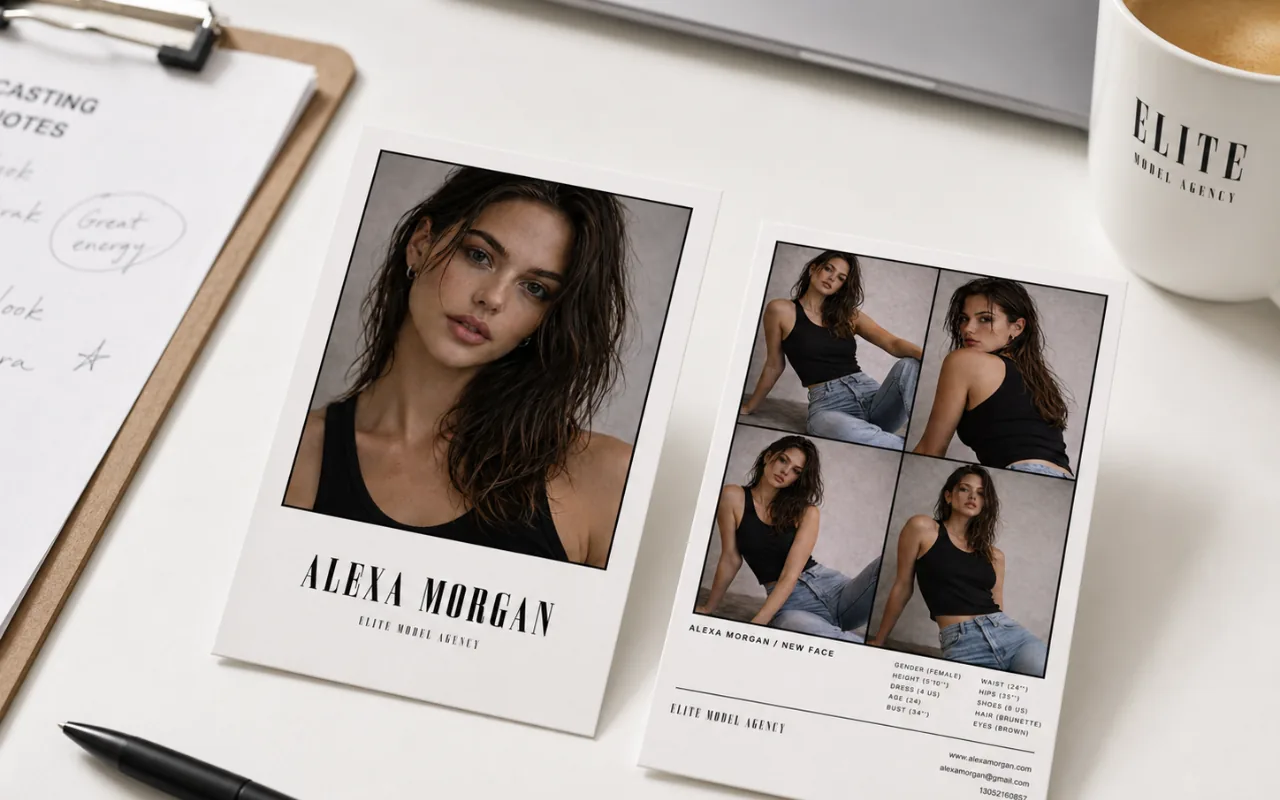
If you are breaking into fashion, commercial modelling, or talent work, you will quickly come across the term zed card. Also known as a comp card, composite card, or sed card, it is a simple visual résumé that shows your photos, key stats, and contact details in one place.
For in-person castings, a professional zed card is usually printed on card stock rather than standard office paper or a generic business card template, though requirements vary by market, agency, and whether you are submitting digitally or attending in person.
Signed models may have cards designed through their agency, but freelance and aspiring models often need to prepare their own, especially when applying online, attending open calls, or building early portfolio materials.
Common sizing and print dimensions
Common print sizes include 5.5" × 8.5" in the US and Canada and A5 in many international markets. A5 is not exactly the same as 5.5" × 8.5", always check the agency, casting, or printer requirements before ordering physical cards.
The table below reflects sizes and finishes that are widely used. Your market may differ.
| Specification | United States / Canada | UK / EU / International |
|---|---|---|
| Common physical size | 5.5" × 8.5" | A5 or local printer equivalent |
| Layout style | Double-sided portrait or landscape | Double-sided portrait or landscape |
| Paper / card stock | Thick card stock, often around 12 pt–14 pt | Heavy card stock, often around 300–400 gsm |
| Finish | Matte, satin, or gloss | Matte, satin, or gloss |
Printing and presenting your zed card
If you plan to bring printed zed cards to open calls, castings or agency meetings, choose sturdy paper and a clean way to store them. For many beginners, a digital comp card is enough to start, but physical cards can still be useful when you are meeting people in person.
Disclosure: This section contains affiliate links. If you buy through these links, The Looksheet may earn a commission at no extra cost to you. As an Amazon Associate I earn from qualifying purchases.
Heavy matte cardstock
Useful if you want to test-print your card at home before ordering professional prints. Look for smooth white cardstock around 100–110 lb cover weight, or around 300gsm outside the US. View on Amazon(paid link)
Half-letter or A5 blank cards
Useful if you want to print cards close to common comp-card sizing. Always check your printer settings and trim requirements before printing. View on Amazon(paid link)
Portfolio display book
Useful for keeping printed photos, tear sheets, test images or comp card samples organised for castings and meetings. View on Amazon(paid link)
Clear protective sleeves
Useful for storing printed comp cards so they do not bend, scratch or pick up marks in your bag. View on Amazon(paid link)
What to include on a zed card
Requirements vary by agency and market, but most zed cards include some combination of the following:
- Full name or modelling name
- Agency or independent status
- Market / location
- Height
- Bust / chest, waist, hips
- Shoe size
- Hair colour
- Eye colour
- Email or contact method
- Instagram or portfolio link
- Headshot
- Full-length image
- Two to four additional images showing range
Digital vs printed zed cards
Today, many models use digital comp cards for email submissions, online castings, and portfolio links. Printed cards are still useful for in-person open calls, castings, networking events, and agency meetings. If you are just starting, create a clean digital version first, then print once you are happy with the photos, layout, and details.
Generate your card instantly
Designing these layouts from scratch in traditional graphic editors can take hours of micro-adjustments. The Looksheet helps you build a clean digital comp card quickly, upload your images, enter your stats, and export a print-ready file in less than a minute. For the full workflow (templates, live preview, and export), see How it works.
Create your zed card free